| John Broskie's Guide to Tube Circuit Analysis & Design |
|
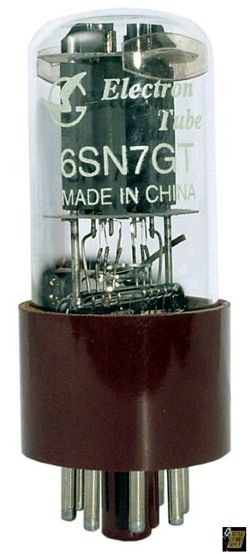
Post 236 03 July 2012 Octal CCDA Tube Types The 12SX7 is great tube and it sells for about $30 today. It was designed to work under low B+ voltages, as found in aircraft. Building a relatively low-voltage octal CCDA, with a B+ of 120Vdc, would make a fun project. A 120Vac secondary will rectify up to about 165Vdc, which can then be reduced to 120Vdc by the RC filters on the PCB. The big advantage that this low B+ voltage offers is that the power-supply capacitors are much greater in capacitance at a 200V voltage rating, rather than at 400V. The Chinese brown-base 6SN7 is fine little tube, which is why it is used in so many $5,000 tube preamps and power amplifiers. At $10 each, they are a bargain.
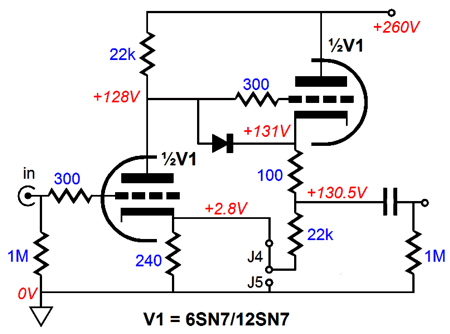
A 6SN7, unlike the 12SN7, requires more B+ voltage to sing. I used a 240Vac secondary, which rectified up to about 330Vdc after the rectifiers, which fell to 260Vdc at the tubes. Since the triodes in the CDDA circuit see half of the B+ voltage, each triode sees 130V from its cathode to its plate. With the 22k plate and cathode resistors that I used, the plate dissipation is only 0.75W and the idle current for each triode is a tad less than 6mA.
I used the same positive feedback arrangement that I used in my Tetra Sans PS and Noval CCDA, so the signal gain came in at +23dB (or 1:14). And once again, I am hearing the same spritely sound that the Noval CCDA with positive feedback produced. And once again, this CCDA is dead quiet.
The only thing that I don't like about the octal version is the height of the tubes, which makes placing this CCDA in a 3-inch tall enclosure impossible. On the other hand, this CCDA would look great with the tube protruding from the chassis. How is that possible? I have placed redundant regulator pads on the bottom of the PCB, so all the parts, save for the tube sockets, can be placed on the bottom. The Rev. A Octal CCDA PCB and kits are available at the GlassWare/Yahoo store now.
Next Time
//JRB |
|
I know that some readers wish to avoid Patreon, so here is a PayPal button instead. Thanks.
John Broskie
E-mail from GlassWare customers:
And
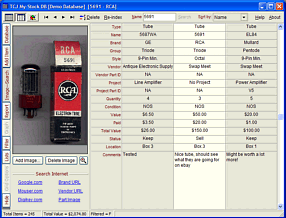
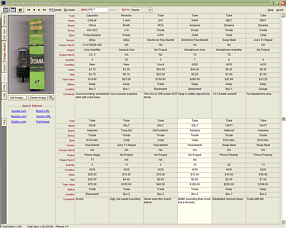
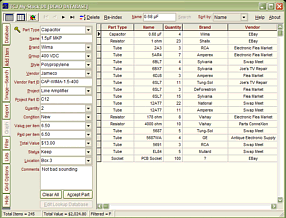
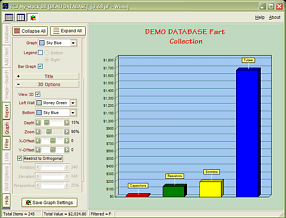
High-quality, double-sided, extra thick, 2-oz traces, plated-through holes, dual sets of resistor pads and pads for two coupling capacitors. Stereo and mono, octal and 9-pin printed circuit boards available.  Aikido PCBs for as little as $20.40 http://glass-ware.stores.yahoo.net/ Only $12.95 TCJ My-Stock DB
Version 2 Improvements *User definable Download or CD ROM www.glass-ware.com |
||


| www.tubecad.com Copyright © 1999-2012 GlassWare All Rights Reserved |